Pay analytics & compensation research
Send us what you already hold. Offers you made, salaries you pay, people who left.
We turn it into a pay structure you can defend, anchored to public official statistics. You see the finished deliverable first. You decide afterwards.
And if the data cannot leave your building, we ship you the model instead and you run it yourself.
No licensed survey data. Those licences forbid redistribution, so a report built on them cannot show its own working. Ours can.
Why people call us
Why the analysis matters
In 2022 a company in Warsaw awarded its team eight percent. Prices rose by 14.4 percent that year. It was a pay cut, delivered in a letter that said congratulations.
Everything below the dashed line is a real increase. Everything above it is a real cut. In Poland in 2022 a four percent budget was worth minus 10.4 percent. The four percent line is an illustration, not a published figure. Your own budget, applied to your own locations, is the first thing we compute.
The work
Three working models you can pull apart right now, then a finished deliverable. Everything here runs on sample figures. The point is what happens when the numbers are yours.
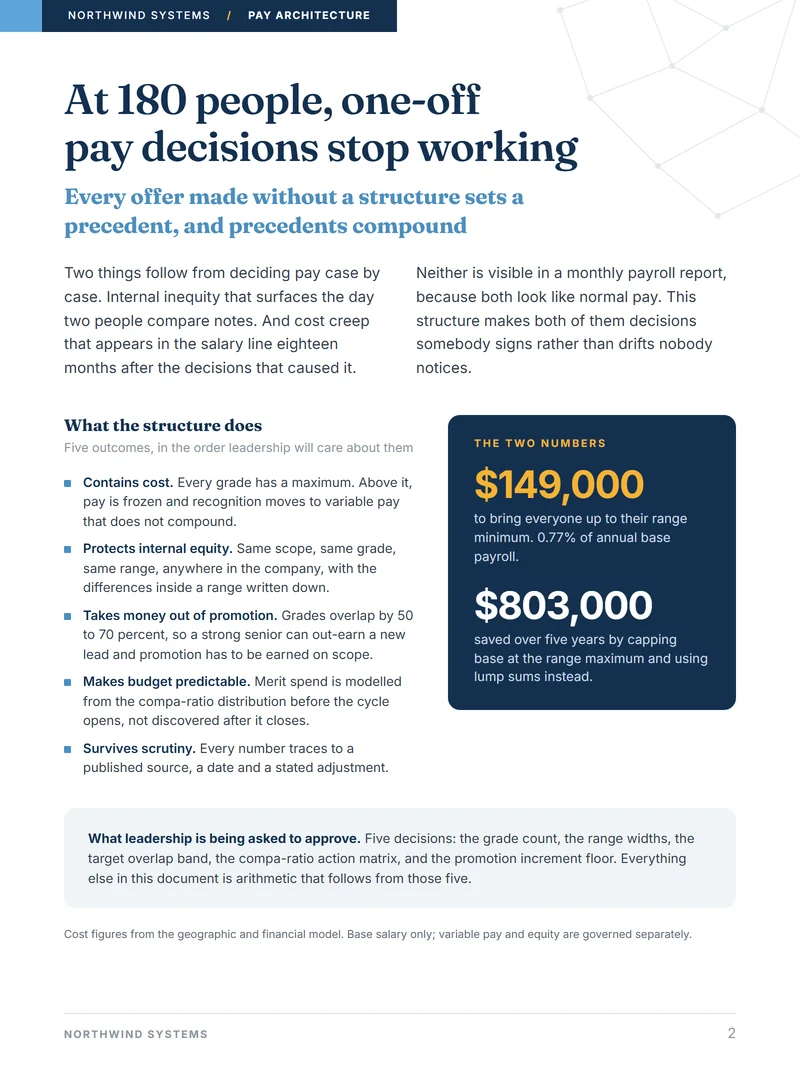
And here is what a finished deliverable looks like. A full pay architecture for a fictional company of 180 people across three countries, sent in full before anyone asks.


If it looks like something you would put your name on, tell us what you are trying to solve. If it does not, no conversation was needed.
Take one with you
Most of what we produce is published under somebody else's name. A search firm's annual salary guide. A consultancy's band structure. A vendor's research report. The people reading those documents are not supposed to know we exist, and the firms who commission them are not looking for a case study about themselves.
So instead of logos, here is the thing a logo is meant to stand in for. The models above are live and you can break them. The deliverable is shown in full rather than described. The method is published in enough detail that you can check the arithmetic yourself. Judge the work, because that is all a reference would have told you anyway.
Two ways to work
Pay data is the most sensitive data in the building. Plenty of leaders want the analysis and simply cannot send salaries to an outside domain, whether that is policy, legal, works council or instinct. That objection usually ends the conversation. Here it does not.
You share offers, payroll and attrition under an NDA. We build the analysis and hand back the finished deliverable.
You send us nothing. We build the model against sample figures, ship you the whole package, and you drop your own numbers in behind your own firewall. We never see a salary.
Every one of these ships either way, as a finished deliverable or as a model you run yourself.
Not sure which route fits? Tell us what the constraint is and we will say which one we would pick in your position.
The difference
None of these are claims about working harder. They are structural, and they are the reason this practice exists.
Engagements
The capability list above is what we can build. These are the four pieces of work people actually ask for, and any of them can arrive as a finished deliverable or as a model you run yourself.
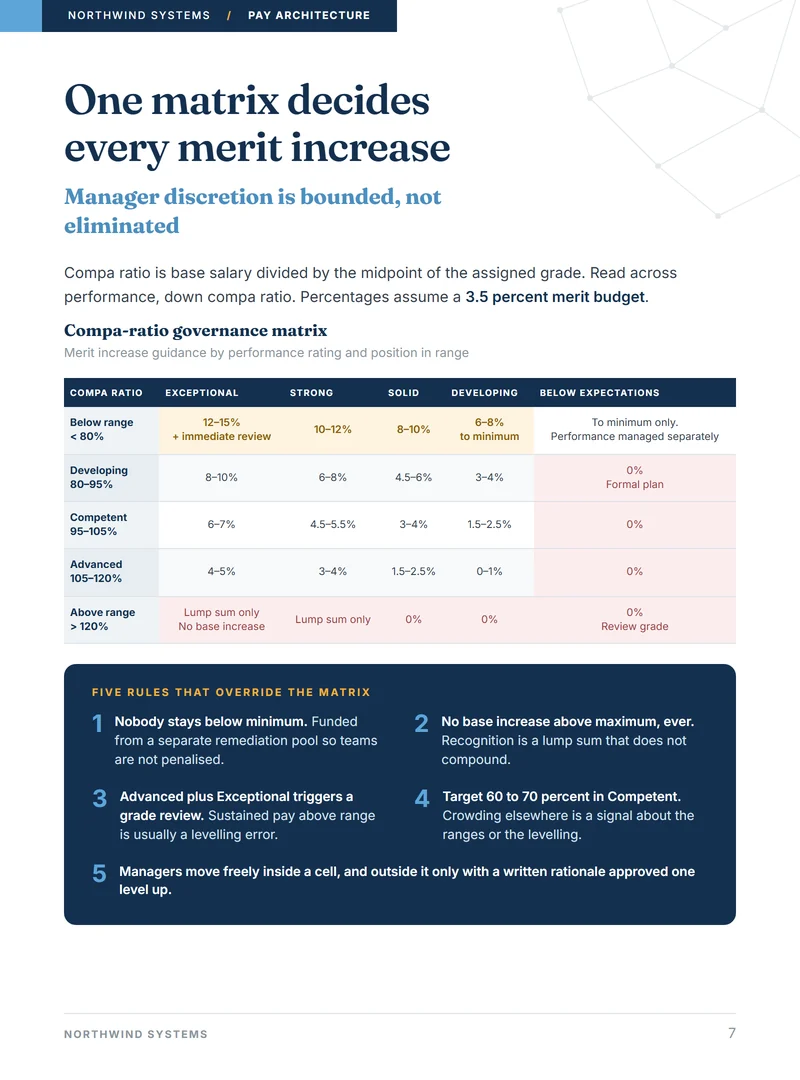
Grades, ranges, midpoint progression and overlap. A compa ratio matrix so managers apply a rule instead of negotiating. Level descriptors that settle a promotion argument in writing. Geographic differentials that move the whole range, so a promotion means the same thing in every country.
The annual guide your firm publishes, produced for you. Built on public official statistics with the derivation documented well enough that a sceptical reader can check it, which is what makes a prospect forward it internally rather than skim it.
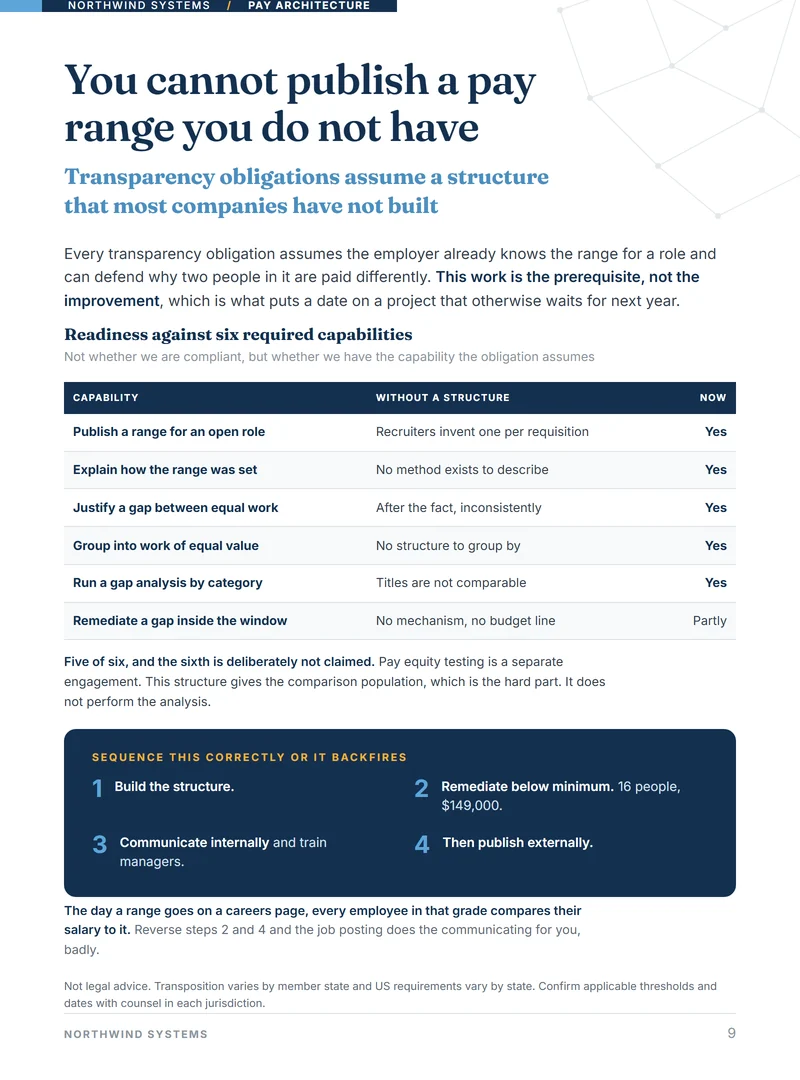
You cannot publish a pay range you do not have. We build the structure that makes disclosure possible, quantify what it costs to bring everyone above their range minimum, and sequence the rollout so a job posting is not what tells your team.
Most companies build a structure and never explain it, so nobody believes it. We write the plain language piece that answers the eight questions people really ask, including the awkward ones about why a colleague earns more.
Why this became urgent
The reporting year for the first deadline is the calendar year you are currently in. Whatever your pay data looks like over the coming months is what gets reported.
There is a second clause that catches most people. Where an unexplained gap of five percent or more shows up in any category of worker and is not resolved within six months, the employer has to run a joint pay assessment with worker representatives. You cannot explain a gap by pointing at a structure you never built, and you cannot publish a range you do not have.
None of this is legal advice and the detail differs by member state, so take local counsel. The structural work underneath it is the same everywhere, and it is the part that takes time rather than the part that takes a lawyer.
Directive (EU) 2023/970, Articles 9, 10 and 34.
The method
Five steps. Each one is recorded in the deliverable, so any figure can be traced back to a source, a date and a stated adjustment.
Step 04, in plain terms
This is what keeps the work honest in both directions. It stops six data points being treated as truth, and it stops sixty being ignored because a published table felt more official. If your sample is thin we say so, and the structure is marked provisional.
Who we work with
You publish an annual salary guide because your market expects it. We produce it, under your name, so your researchers can stay on searches.
Capacity is the bottleneck, not demand. We are the production layer behind band structures and job architecture your clients never see us build.
The State of Compensation report your category expects. Built so a prospect can check it, which is what makes it travel.
The size where pay decisions stop scaling one at a time and every offer quietly becomes a precedent.
What we hold ourselves to
Values are cheap to write and expensive to keep. These are the four we are prepared to be measured against, defined so you can tell when we have failed one.
What happens next
Said plainly, with dates, so it is a process rather than a promise. There is no discovery phase you pay for and no proposal document to sit through.
Straight answers
To scope it, three lines: headcount, functions, countries. To build it, an extract with an employee reference, a grade or job title, a location and a base salary. Names are not needed and we would rather not have them. Offers made, accepted and declined, plus leavers with their exit dates, make the analysis considerably sharper, but they are not required.
A spreadsheet is fine. We do not connect to your HRIS and we do not want credentials for anything.
A pay structure inside a week from the day the data lands. A white label research report or salary guide inside three. The pilot comes back within five days of your first email.
These are short because the analysis is engineered rather than assembled by hand. If something will take longer, you are told the date up front rather than discovering it later.
A fixed price per deliverable, agreed before we start. No hourly billing, no day rates, no change orders and no discovery phase you pay for. You know the number and the date before anything begins.
We price the artefact, not the effort, which means an efficient method benefits you rather than costing us. Nothing is billed until the pilot has been seen.
A fair question to ask anyone in 2026, and the honest answer is both. Software does the arithmetic, the aging, the interpolation and the document build, which is exactly why the turnaround is days rather than months. The judgement is not automated: which occupational codes actually map to your roles, which comparator market you are really in, when a sample is too thin to carry a conclusion, and when a number is technically correct but would mislead the person reading it.
The reason you do not have to take that on faith is the method. Every figure ships with its source, its retrieval date and the adjustment applied, so you can reproduce any number in the deliverable yourself. Work that cannot survive being checked is not worth buying, whoever or whatever produced it.
Yours. We sign your paper and invoice against it. We are a registered proprietorship and we contract in our own name.
If your legal team would rather nothing left the building at all, that is what the second route exists for. You send us nothing, we ship you the model, and there is no data to protect because we never receive any.
You do, outright, on payment. Including the models and the spreadsheets, not just the finished document. You can edit them, rebuild them next year without us, or hand them to another firm.
We keep no residual claim and we do not reuse your figures in anyone else's work. Nothing we build for you carries our name unless you ask it to.
Then we say so on the page. Your own evidence is weighted by how much of it there actually is, so six data points do not get treated as truth and sixty do not get ignored because a published table looked more official.
Where the sample cannot carry a conclusion, the structure is marked provisional and the reason is written down. A confident number built on nothing is the most expensive thing in this field.
We are a registered proprietorship operating from India, working across UK, EU, US, Gulf and Indian pay markets. Contracting and invoicing are in our own name.
Data you send stays on encrypted storage under our control, is never placed in a shared drive or a third party analytics tool, and is returned or destroyed on completion, your choice, confirmed in writing. If cross border transfer is the obstacle rather than a preference, take the model route instead and the question does not arise.
Get in touch
A headcount, a function and the countries involved is enough to begin. We will tell you before you commit whether we are the right people for it, and if we are not, we will say so.
The button opens your mail client with the three questions already in it. Or write to [email protected] however you like.